1. Even in its nascent phase, Pakistan willingly undermined itself by playing second fiddle to the United States. Liaqat Ali Khan, Pakistan's first prime minister, refused Soviet overtures, choosing instead to pay a visit to the White House. That decision permanently palled Pakistan-Soviet relations.
2. In 1954 Pakistan joined SEATO and CENTO, the US-led defense alliance against the Soviet Union although Pakistan per se had no dispute with the USSR.
3. In 1955 Pakistan became a member of the British-led and US-backed Baghdad Pact. The purpose of the Pact was to contain possible Soviet influence in the Middle East. Strangely, Pakistan did not belong within the geographical arrangement of the Pact. It joined just to please the Americans.
4. In 1959 Pakistan allowed the US to establish secret intelligence facilities near Peshawar so that the Americans could spy on the Soviet Union. Pakistan constantly denied Soviet allegations that the US was spying on it using Pakistan’s territory. In 1960 the infamous U-2 spy plane was shot down by the Soviet army. The plane had as usual taken off from Peshawar. Khrush- chev threatened to attack Pakistan if the Peshawar-based espionage facilities of the US were not dismantled. Pakistan partially complied.
5. In March 1959 Pakistan-US signed a bilateral security agreement which called upon the US to take such appropriate action, including the use of armed forces. This was a total act of subordination on Pakistan's part because the commitment was restricted to instances of communist aggression. It made no reference to the US coming to Pakistan's help in the event of a conflict with its most likely adversary, i.e. India.
6. In January 1961 the new Kennedy administration increased assistance to India to $1 billion annually, while giving only $150 million to Pakistan. Pakistan had done nothing to deserve this ill-treatment.
7. In 1964 President Johnson conveyed his distress over Pakistan's good relations with China, but after a few years it was Pakistan which served as a go-between when the US and China began to normalise their relations.
8. In September 1965 Pakistan and India went to war. The US responded by suspending military and economic aid to Pakistan.
9. In May 1974, following India's "peaceful nuclear explosion," Z.A. Bhutto, then Pakistan's prime minister, pledged to press ahead with Pakistan's nuclear program. The US pressured him not to, but he stood up to the Americans. In 1976 he was threatened by Henry Kissinger with "horrible" consequences for pursuing a nuclear program. (Kissinger's exact words: "We will make a horrible example out of you." See Endnote 1.) Soon after, he was deposed and executed by the Pakistani Army.
10. From 1979 to 1988 Pakistan fought the American cold war against the Soviet Union. Knowing full well that the Afghan crisis of the late 1980s could have destructive consequences for Pakistan, its rulers (the generals) became willing instruments of the Americans. This resulted in Pakistan's becoming a centre of mercenaries, illegal arms and heroin.
INDEPTH DETAIL OF PAK-US CONNIVANCE.

General Ayub and US Vice President later President of the US Lyndon B Johnson having fun

Pakistan First Chief Martial Law Administrator / Dictator General Ayub Khan with Democrat US President J F Kennedy and US Vice President Lyndon B Johnson

Immediately after independence in 1947, Pakistan’s apprehension about the designs of a hostile large neighbour, India prompted it to try to develop friendly defence relations with large powers (US and later China). Very early in the game, politicians lost the control of defence related matters due to their lack of experience and constant squabbles. This allowed the British trained bureaucrats and military officers to take control of the affairs especially those related to defence. Defence and foreign policy are closely linked to each other, therefore, invariably a particular decision about defence has both foreign policy and domestic impact thus complicating the picture. A glimpse of thought process of the decision makers will help to understand why a particular decision was taken whenever they got the chance of acting on their thoughts. Governor General Ghulam Muhammad during his conversation with Vice President Nixon, pleading for military aid stated that, “... were the US not grant aid now, especially in view of all publicity, it would like taking a poor girl for a walk and then walking out on her, leaving her only with bad name”.
Foreign Minister Zafrullah Khan was more candid when in 1954, during a meeting with Governor Stassen asking for more aid stated, “It was Pakistan’s belief that the “beggar’s bowl” should never be concealed”.
Ayub Khan frustrated with slow pace of negotiations with US during his visit to Washington went to Henry Byroad’s office and told him, ‘I didn’t come here to look at barracks. Our army can be your army if you want us. But let’s make a decision’.
In 1950-53, a flurry of Pakistani officials landed in US asking for assistance. Prime Minister Liaqat Ali Khan, C-in-C Ayub Khan, Foreign Minister Zafrullah Khan, Foreign Secretary Ikramullah, Finance Minister Ghulam Muhammad, Defence Secretary Sikander Mirza and special envoy Mir Laiq Ali made US visits with main theme of getting aid. Each one of them believing that he is the most capable one who could do the job of getting American assistance better than anybody else.
Once US decided about Pakistan’s role in the defence of the region and containment of Communism, it was the armed forces of Pakistan and not the political leadership, which was seen as potential partners. Ayub Khan obsessed with modernization of the armed forces in shortest possible time saw the relationship with US the only way to achieve his organizational and personal objectives. In meeting with US officials during his April 1958 visit, Ayub stressed that armed forces are the strongest element. He was of the view that if elections were held in the prevailing circumstances, the left wing politicians will come to power which will not only destabilize Pakistan but will affect US strategic interests.Pakistan was seen by the US in military terms which were quite natural as US national interest was related to security. In 1953, Pakistan was described as a country with many qualities, which were, “... a volunteer army of 3,000,000... it is not neutral but anti-communist... As a possible ally for the US, Pakistan displays a tempting picture of power — potential and actual”.Pakistan army was seen as ‘a disciplined, well-trained army whose morale and bravery are unquestionable’.Some events in Washington regarding Pakistan became comical. In 1953, Secretary of State John Foster Dulles while arguing for wheat aid to Pakistan told sub-committee on Agriculture and Forestry during hearings that, ‘the people of Pakistan had a splendid military tradition and that in Karachi he had been met by a guard of honor which was the ‘finest’ he had ever seen’.Apparently, he did not tell the agriculture department what on earth the wheat aid has to do with the military. After the signing of the first mutual defense treaty on May 1954, large-scale interaction between the US and Pakistani military started. Pakistan became one of the seven members (other members included Thailand, South Vietnam, Taiwan, Philippines, Laos, and Cambodia) of elite ‘Defence Support Countries” in South East Asia. A US Military Assistance Advisory Group (MAAG) was established in Army Headquarters in Rawalpindi. A Military Assistance Programme (MAP) was started. Pakistan's army was divided into MAP and Non-MAP units depending on their role. MAP units were oriented towards safeguarding US interests and non-MAP units along the Indian border.
The objectives of the US and Pakistan were different in this military alliance. For the US the arrangement was to safeguard US interests in southwest Asia and the Middle East and not against India. Pakistani military establishment saw the relationship as a short cut to the modernization of its armed forces but failed to comprehend the long-term strategic interest of Pakistan. One frequently hears the complaints of Pakistani officers from top to bottom about ‘betrayal’ and ‘abandoning’ by America. The fact that the US was following her national interest while mediocre Pakistani military leadership was more in wishful thinking rather than planning for safeguarding their national interest. There was nothing secret about US policy. In several public statements and documents, US objectives have been clearly stated, if Pakistani generals could not see them, this was their own folly. The general principles of these security agreements were that the United States will enter a security agreement when:
- There is a genuine threat to US interests.
- The mutual security pact will significantly contribute to preserving these interests.
- The final judgment of US troop commitment will be made by elected representatives.
- Allies will contribute their fair share in terms of personnel, weapons, resources and government support.
As early as 1962, Colonel Jordan wrote about US position as far as Pakistan was concerned, “... because of their deployment, the Pakistani forces in Eastern Pakistan and Kashmir (Non-MAP supported) are the ones most likely to become entangled with the Indian Army should an incident arise. US responsibility for such non-MAP Pakistani forces is no greater than for Indian Army units, which have indirectly benefited by the massive US economic aid given to India”. While Colonel Jordan wrote with precision and clarity, Major General Fazal Muqeem Khan was baffled. Muqeem wrote, “It would be interesting to know why the United States did not take over the responsibility of supporting the entire standing army at the time of the agreement. Those parts of the army, which are now in Kashmir and East Pakistan, and some other units, do not have military assistance. Similarly, no training establishments or static installations are supported”.These few words speak a volume about the intellectual level of senior leadership.
In July 1959, Pakistan agreed for the establishment of a US base near Peshawar to be operated by US officials. General Khalid M. Arif while commenting on the U-2 incident (U-2 was a US spy plane operating from Badaber base near Peshawar. It was shot down by Soviet SA-2 missile and its pilot Gary Powers was captured. The incident severely compromised Pakistan's security and brought the Soviet ire on Pakistan. Soviets paid back Pakistan within a decade during East Pakistan crisis) states that, ‘Pakistan felt deceived because the US had kept her in the dark about such clandestine spy operations launched from Pakistan’s territory’.Statements like these from such highly placed officers don’t speak well for Pakistan. As early as 1959, when Zulfikar Ali Bhutto, as acting foreign minister wished to visit the facility, the American base commander replied that ‘the minister would be welcome to visit the cafeteria where he would be served coffee and sandwiches’.An American air force base located in the border area of Pakistan near Soviet territory where spy planes were parked, run by Americans where even the highest Pakistani officials could not enter did not suppose to bake cookies or train pilots for aerial acrobatics. Ayub Khan was fully aware of the operations. He was in London at the time of U-2 incident. When the CIA station chief gave Ayub the news, he shrugged his shoulders and said that he had expected this would happen at some point. In the 50s there was an increasing number of Pakistani officers who got training in the United States. The military doctrine shifted from British to American. Fazal Muqeem points to the change of thought process of officer corps. “Such healthy and friendly contacts were bound to have a decisive influence on the ideas of the officer corps. They soon made their impact on the thinking of Pakistani commanders and staff. In the re-organization of the army, American ideas influenced the planners in a number of ways”.The influence was not limited to the knowledge of new weaponry and defense strategy and tactics. According to Colonel Jordan, the purpose of training of officers in the US was not only to train them in particular fields but also to groom them for non-military activities (leadership, management, and economics). In addition, MAAG officers were in agreement that the off-shore trained officer is more receptive to continued military advice and suggestions than his colleagues”.It is interesting to note that officers from different countries (Asia, Africa, Latin, and South America) trained in the US quite confident of their newly acquired skills took power in their own countries.
In the early phase after independence, US military assistance undoubtedly increased Pakistan’s defense capability vis-a-vis India in the short term. On the other hand, it strengthened the hands of non-representative segments of government (military and bureaucracy) compared to the representative segment (politicians). Armed forces by opening a direct channel to a superpower effectively bypassed the budgetary nuisances, the single most important factor for effective civilian control of armed forces. The non-representative group thus energized by the material and moral support of the US very easily strangulated the nascent democratic process. On the domestic front, the concentration of all armed forces in West Pakistan caused apprehension in East Pakistan. The reason was two-fold. One, Eastern wing being encircled by India on three sides was more vulnerable to Indian attack but had nominal troops. Second, the economic benefits of military aid (job opportunities, civilian contracts and beneficial effects on the local economy) were concentrated in the Western wing. The defense policymakers failed to adjust from a colonial mold into that of an independent nation. The simple fact that no group in a multi-ethnic society like Pakistan wants to see itself as dispensable or less important and not worth defending. The absurd defense concept of defense of Eastern wing from Western wing which was inherited from the colonial rule convinced Bengalis that they were dispensable. The democratic tendency and anti-American sentiment was stronger in East Pakistan. When the mutual defense treaty was announced in February 1954, there was a great outcry in the eastern wing. Many demonstrations were held and 162 newly elected members of East Bengal Provincial assembly signed a statement, which denounced the Pakistani government for signing a military pact with the United States.
The first twenty-year period after independence was crucial in terms of international relations. One factor which most Pakistani historians have ignored is that in the period of 1951-53 there were high-level meetings between Pakistani and Indian counterparts at different levels including Prime Ministers about Kashmir issue. India had accepted Kashmir as a central issue between the two countries. The two Prime Ministers had met in August 1953. India had agreed in principle about the plebiscite and it was decided that a Plebiscite Administrator would be appointed by the end of April 1954. Pakistan’s joining of American sponsored pacts gave Nehru the golden chance to renege completely on all assurances. With the benefit of hand sight, one can only guess that probably at least by delaying the announcement of the mutual treaty with the US would have provided the opportunity to test Indian sincerity. Pakistan’s alliance with the US naturally brought the anger of the Soviet Union. Soviet Union’s early neutral stand on Kashmir quickly changed to a pro-India stance. On the international scene, Pakistan was effectively kept out of the non-aligned movement. Several newly independent countries in Asia and Africa were either neutral or actively hostile to Pakistan. In the 50s, there was a favorable opinion of Pakistan in US government executive and legislative branches and media. When the relationship with the US took a downward turn during the Kennedy and Johnson administration, Pakistan was totally lost as to how to respond to changing scenarios. It maintained membership in all security pacts thus still taking the heat from antagonists of the US. At the same time, it stopped taking part in military exercises or in Intelligence Assessment Committee studies thus not getting any tangible military benefit. It continued to attend the meetings but its delegates neither participated in discussions nor took part in the drafting of communique.

Pakistan's Second Martial Law Administrator General Yahya Khan with US Republican President Richard Nixon.

As per Ms. Anjum Niaz
(Sealed off as 'Top Secret' by the State Department and CIA, now after three decades, 46 declassified documents - some 'sanitized' - and an audio clip of Nixon-Kissinger offer a compelling peek at President Nixon and his security advisor Henry Kissinger giving a sly wink to the Pakistan army to kill, rape and terrorize innocent East Pakistanis during the 1971 India-Pakistan crisis)
Inside the Oval Office, August 2, 1971, an exasperated President Nixon and his national security advisor Henry Kissinger curse India for wanting to pick up a fight with Pakistan. Actually, the timing is skewed for Nixon who has clandestinely taken a shine to Chou En-Lai facilitated by Pakistan President Gen.Yahya Khan. But the "god-damn Indians" - as Nixon and Kissinger call them - are giving the Americans a run for their money by refusing to sit and watch silently the two siblings - East and West Pakistan - slug it out with each other.
"We have already given 100 million dollars to India for the refugees (pouring in from E. Pakistan)," Kissinger informs Nixon who is convinced the US is "making a terrible mistake" by heaping dollars on New Delhi. "India is economically in good shape, but no one knows how the god-damn Indians are using this money. They are not letting any foreigners enter the refugee areas. Any foreigners and their record is outrageous!" keen Kissinger.
The White House conversation comes the day after the Beatle George Harrison and his soul mate Ravi Shankar, the Indian sitar player hold a "Concert for Bangladesh"(months before its birth) to raise money for the refugees escaping the reign of terror unleashed by Pakistan army after Mujibur Rehman's Awami League has swept the polls in East Pakistan during the 1970-71 general elections but is now being outlawed.
"So who is the Beatle giving the money to - is it the god-damn Indians?" asks a frustrated Nixon. "Yes," says Kissinger flatly, adding that Pakistan has also been given $150,000 food aid but the major problem "is the god-damn distribution." Nixon jumps in, "we have to keep India away". Kissinger couldn't agree more: "we must defuse the refugee and famine problem in East Pakistan in order to deprive India (read Indira Gandhi) of an excuse to start the war with Pakistan."
"We have to avoid screwing Pakistan that outrageously. It could blow up everything," concurs Kissinger. And the solution according to him is: "we should start our god-damn lecturing on political structures, as much as we can and while there will eventually be a separate East Bengal in two years (he says it so very casually) but it must not happen in the next six months."
As per David Corn
Hundreds of thousands were killed. Kissinger blocked US condemnation of Khan. Instead, he noted Khan's "delicacy and tact."
Famous Pakistani Laureate par excellence Late. Mr. Eqbal Ahmed in one of his interview with David Barsamian had said,
"That was something you couldn't do doing the military rule?
That was something I could not do for thirty years.
Because of military rule?
Yes. In the first military rule of Ayub Khan, there was a warrant of arrest on me. In the second military government of Yahya Khan, I was put on a death sentence. In the third military government of Zia ul-Haq, I was a persona non grata for over eleven years. Now I am able to go back. Parliamentary government has been restored. It's at least formal democracy. I would like to see it become a truer democracy, but I would also like to see the United States become a truer democracy. What is more interesting about Pakistan is that greater freedom of speech and association has drastically reduced the power and influence of the Islamic movement. More people are able to speak out challenging the premise of fundamentalism, and fresh air seems to blow away the worst of religious right-wing thinking. I am mentioning this because countries like Egypt and Algeria, which are constantly facing the fundamentalist threat, should learn from it. A great deal of Islamic fundamentalism thrives on the absence of freedom, as it did in the Iran of the Shah. Dissent has no place to go except the mosques. The answer to the fundamentalist divide is more democracy, not more dictatorship. The tragedy is that the United States government, while opposed to fundamentalism now, I say now because I'll come back to it later, supports dictatorships in Algeria, in Egypt and repressive monarchies in Kuwait and Saudi Arabia. So the United States is actually supporting both fundamentalist and non-fundamentalist dictatorships in the Middle East, from Saudi Arabia to Algeria. This has to stop. If there is a democracy, I think the battle can be fought in an open field and we are going to win. By "we" I mean the secular Muslim forces.

Pakistan's Third Martial Law Administrator General Zia
 General Zia with US Republican President Ronald Reagan
GENERAL ZIA UL HAQ.
U.S. government under President Ronald Reagan approved Pakistan's military dictator, Mohammad Zia ul-Haq, a five year, multibillion-dollar armaments package with Congress overriding legislative requirements on human rights and nuclear proliferation. Likelihood of augmentation of political repression by the praetorian regime; Destruction of the judiciary system of Pakistan by the regime of Zia; Constitutional order passed by Zia on March 25, 1981.
Zia was born in Jalandhar (in India) in 1924. He completed his initial education in Simla and then at St. Stephen's College, Delhi. He was commissioned in the British Indian Army in a cavalry regiment in 1943 and served during World War II. At Pakistan's independence, Zia joined the newly formed Pakistani Army as a major.[red] He trained in the United States 1962–1964 at the U.S. Army Command and General Staff College Fort Leavenworth, Kansas. Zia was stationed in Jordan from 1967 to 1970, helping in the training of Jordanian soldiers, as well as leading the training mission into battle during the Black September in Jordan operations. On 1 April 1976, Prime Minister Zulfiqar Ali Bhutto appointed Zia-ul-Haq as Chief of Army Staff, ahead of a number of more senior officers.
As per the book “Charlie Wilson’s War by George Crile during the so-called Afghan Jihad following things did happen;
“He told Zia about his experience the previous year when the Israelis had shown him the vast stores of Soviet weapons they had captured from the PLO in Lebanon. The weapons were perfect for the Mujahideen, he told Zia. If Wilson could convince the CIA to buy them, would Zia have any problems passing them on to the Afghans? Zia, ever the pragmatist, smiled on the proposal, adding, “Just don’t put any Stars of David on the boxes” {Page 131-132}.
Pseudo Commander of the Faithful General Zia ul Haq appointed a ‘Society Lady’ Joanne Herring as Pakistan’s Honorary Consul in Houston, Texas USA, earlier her husband Bob Herring was offered the post but he declined and gave his wife’s name.
“She was Zia’s most trusted American adviser, as per Sahibzada Yaqub Khan, She absolutely had his ear, it was terrible,” “Zia would leave cabinet meetings just to take Joanne’s calls. “There was no affair with Zia,” Wilson recalls, but it’s impossible to deal with Joanne and not deal with her on sexual basis. No matter who you are, you take those phone calls.” {Page 67-68}.
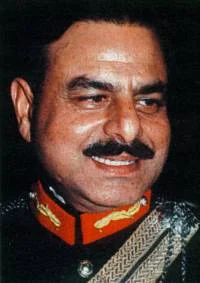 Lt General Retd. Hamid Gul [Former ISI and MI Chief]
Former Director General (DG) of Inter-Services Intelligence (ISI), Lieutenant General (Retd) Hameed Gul’s anti-American rhetoric in the post-retirement phase makes headlines off and on in national news media/even on ARY GEO AND INDUS VISION too. It is interesting that when he was DGISI, the US ambassador attended the meetings of the Afghan Cell of Benazir government. In fact, the major decision of the Jalalabad offensive in 1989 was made in one of those fateful meetings. To date, there has been no evidence (no statement by any other participants of those meetings or by General Hameed Gul himself) that Mr. Gul made any objection to the presence of US ambassador in these meetings, which had a wide-ranging impact on national security. It is probable that Mr. Gul was at that time a top contender for the Chief of Army Staff (COAS) race, therefore he didn’t want to be on the wrong side of the civil government. When he was sacked, then he found the gospel truth that the US was not sincere. Another example is of former Chief of Afghan Cell of ISI, Brigadier (Retd) Muhammad Yusuf. For five long years, he was a major participant in a joint CIA-ISI venture of unprecedented scale in Afghanistan. During this time period, he worked with several different levels of US officials and visited CIA headquarters in Langley. In his post-retirement memoirs, he tried his best to distance himself from the Americans. His statements like, ‘Relations between the CIA and ourselves were always strained’, ‘I resorted to trying to avoid contact with the local CIA staff’, ‘I never visited the US embassy’ and vehement denial of any direct contact between CIA and Mujahideen shows his uncomfortability of being seen as close with the Americans. "Pakistan’s former foreign minister Agha Shahi in a conversation with Robert Wirsing said that in 1981 during negotiations with the US, he gave a talk to a group of Pakistani generals on the objectives of Pakistan’s policy toward the US.
He stressed the importance of non-alignment and avoidance of over-dependence on superpowers. A few days later one of the generals who attended Shahi’s briefing met him and told him that Americans should be given bases in return for the aid. "General Zia and DGISI Akhtar Abdur Rahman had very cordial relations with CIA director William Casey. To offset that uncomfortable closeness with Americans, Zia and Akhtar were portrayed as holy warriors of Islam and modern-day Saladins. According to one close associate of Akhtar, ‘They (Casey and Akhtar) worked together in harmony, and in an atmosphere of mutual trust’. Brigadier Yusuf made the most interesting remarks about the death of CIA Director, William Casey. He states that “It was a great blow to the Jehad when Casey died”. He did not elaborate whether by this definition one should count Casey as Shaheed (a warrior who dies in battle in the cause of Islam). It will quite be amusing for Americans to know that one of their former CIA director is actually a martyr of Islam."
On page 503 in Charlie Wilson’s War, the author quoted “but it was losing Zia that crushed Charlie. At the state funeral in Islamabad, with a million Pakistanis and Mujahideen crowding up to him, Charlie made his way to Akhtar’s successor, Hamid Gul, and broke into tears. “I have lost my father on this day,” he said.
There is nothing new in Musharraf's help of the USA in the region.


