A Complete Blog on All Type of Social and Moral issues Relating To Religion -Politics.Discrimination
Fighting For Peace
No Racist Post
Always Preach Love No Hatred
Admin on Facebook Page
Pakistan Old Pic Lovers
KARACHI: A US State Department official in a meeting urged President Asif Ali Zardari against accepting Iran’s offer of concessional oil for Pakistan and providing Iran with a foothold in Pakistan, a ‘Secret’ American diplomatic cable made available to Dawn reveals. The meeting between Richard Boucher, US Assistant Secretary of State for South and Central Asia during the Bush administration, and President Zardari took place on October 18, 2008 at the Aiwan-e-Sadr, during which Mr Zardari apprised the visiting official of the Iranian offer that the President “did not believe he could refuse.” “How could he go to the National Assembly and tell them Iran had offered the assistance and Pakistan had turned it down, he asked rhetorically,” the then US Ambassador to Pakistan Anne W. Patterson wrote in the cable dated October 22, 2008, referring to President Zardari. She added that, “Boucher reminded him of Ambassador Haqqani’s recent conversation with Deputy Secretary Negroponte in which the Deputy cautioned against providing Iran with a toehold in Pakistan.” The cable illustrates how US officials tried influencing Pakistan’s policy not only with regard to Iran but also indicates how and with whom Pakistan had been dealing with at the time in order to meet its energy requirements. The American caution about Iran oil is consistent with the US government’s efforts to isolate Iran both militarily and economically. The oil offer was discussed months after Pakistan’s Economic Coordination Committee (ECC) had approved the revised gas purchase agreement between Islamabad and Tehran for the import of gas through the Iran-Pakistan gas pipeline (formerly the Iran-Pakistan-India gas pipeline). The US has continually expressed its reservations over the project from which India withdrew in 2008
Months after the talks with Mr Boucher, President Zardari, in a discussion with a Congressional delegation headed by US Senator Patrick Leahy, again referred to Iran’s offer to provide “oil, gas and electricity to Pakistan”, another cable dated May 26, 2009 by Ms Patterson detailing the meeting states. Mr Zardari told the delegation during the May 25, 2009 meeting that “Pakistan desperately needed energy resources” and that “no on else – especially the Saudis” was ready to help. However, in a possible attempt to please the delegation, he went on to say: “I need you more than anyone else, so I will take my cue from you. Perhaps now it will be possible to work with Iran on energy issues.” Interestingly, however, Ms Patterson noted in the cable that President Zardari asked for the “cue” a day after he and Iranian President Mahmoud Ahmadinejad had signed an inter-governmental framework declaration to support the Iran-Pakistan gas pipeline agreement between the oil ministries of Pakistan and Iran. Moreover, around the time of the Boucher-Zardari meeting, along with pursuing the Iran gas pipeline project, Pakistan was in talks with the Chinese government over a deal to build two additional nuclear power plants for the country, once construction of the Chashma II reactor was completed. A contract to cooperate in building the two new nuclear reactors, commonly referred to as Chashma III and IV, at the Chashma atomic complex was eventually signed on June 8, 2010. The development occurred despite misgivings on part of the US and other governments which have every now and then stated that China should seek approval of the reactors from the Nuclear Suppliers Group, a group of nuclear supplier countries that seeks to reduce nuclear proliferation and of which China is a member. On the other hand, the US government was almost simultaneously in touch with Saudi officials regarding Saudi-Pak negotiations to assist Pakistan “by deferring crude oil payments”, a previously published cable dated July 30, 2008 states. It further states that if the US government assessed that a “rapid implementation” of the Saudi offer was “critically important to the Pakistan government’s stability, it will likely take USG intervention at the highest levels with senior Saudi officials…to secure its rapid implementation.” REFERENCE: Cables referenced: WikiLeaks #174700,
When Pakistan was formed in 1947, most of its Hindu
population migrated to India, but not Jagdish Chand Anand. The producer and
distributor stayed back in Karachi after the Partition, and continued to run a
hugely successful business that included the distribution of major Indian
releases in Pakistan.
He was born in 1922 in Bhera, a small town in Punjab’s
Sargodha district. His father was an importer of goods from Japan, but trade
floundered with the onset of WWII. Rather than carry on with his father’s work,
Anand turned his attention to the film industry, working first with a
distribution company in Lahore. He soon graduated to releasing films as a
so-called second party – he would buy the film rights from the main distributor
and run prints in smaller towns or at single-screen cinemas.
After forming his own company, Eveready Pictures, in 1946,
Anand broke through as an important distributor after 1947 by distributing
Indian films, notably the Bombay Talkies smash hit Mahal (1949) and
Raj Kapoor’s films, including Barsaat (1949) and Awara (1951).
As indigenous productions began to slowly emerge in Pakistan
beginning with Dawood Chand’s Teri Yaad (1948), Anand foresaw
challenges in the release of Indian films. With funds largely acquired from
distributing Indian films, Anand decided to do his bit for the Pakistani film
industry, launching his first local film as a producer. Sassi (1954)
was based on the well-known tragic love story of Sassi and Punnu.
Eveready Pictures’ Sassi was a big-budget
production by Pakistani standards. The Urdu movie was directed by Dawood Chand
and starred Sabiha Khanum and Sudhir. Sassi was released on June 3,
1954, and went on to become the first golden jubilee film of Pakistan. Sassi was
even distributed in India, where it was panned by critics. Baburao Patel wrote
in his review in Filmindia, “Sassi is an ugly, rotten seventh rate
picture which makes the spectator restless in his seat ten minutes after its
start. There is not a trace of technical skill, art or imagination in the
entire length of this darkened celluloid. Extremely poorly photographed, more
poorly directed and containing silly performances, shoddy sets and dreadfully
dull music, the picture is a rarely ugly and crude sight and makes one limp
with sheer boredom by the time it traverses its tiresome course to reach its
long awaited end.”
The film made more noise in India due to the fact that it
had plagiarised the popular song “Na Yeh Chand Hoga” from the Hindi film Shart (1954).
Undeterred by the reception in India and encouraged by the
phenomenal response to Sassi in Pakistan, Anand embarked on another
tragic love story. Sohni (1955), based on the legend of Sohni and
Mahiwal, starred Sabiha and was officially produced by MA Khan and directed by
MJ Rana under Anand’s banner. The film didn’t do well at the box office.
Anand returned as producer with yet another famous
star-crossed romance in which the lovers unite in death – Heer and
Ranjha. Heer (1955) was made in Punjabi and directed by actor,
producer and filmmaker Nazir. He cast his wife, Swarnalata, as Heer, while
singer Inayat Hussain Bhatti played Ranjha. The film had extremely popular
songs by Safdar Hussain, who was making his debut as a composer, and was
another smash hit.
Anand was now a producer to reckon with in Pakistan. In
1956, two hugely ambitious productions emerged from his banner. The Arabian
Nights-style fantasy Hatim reunited Anand not just with Sassi director
Dawood Chand but also with actors Sabiha Khanum, Sudhir and Asha Posley from
the previous film. However, Hatim was a setback for Anand, and failed
to match the triumphant run of his previous two productions.
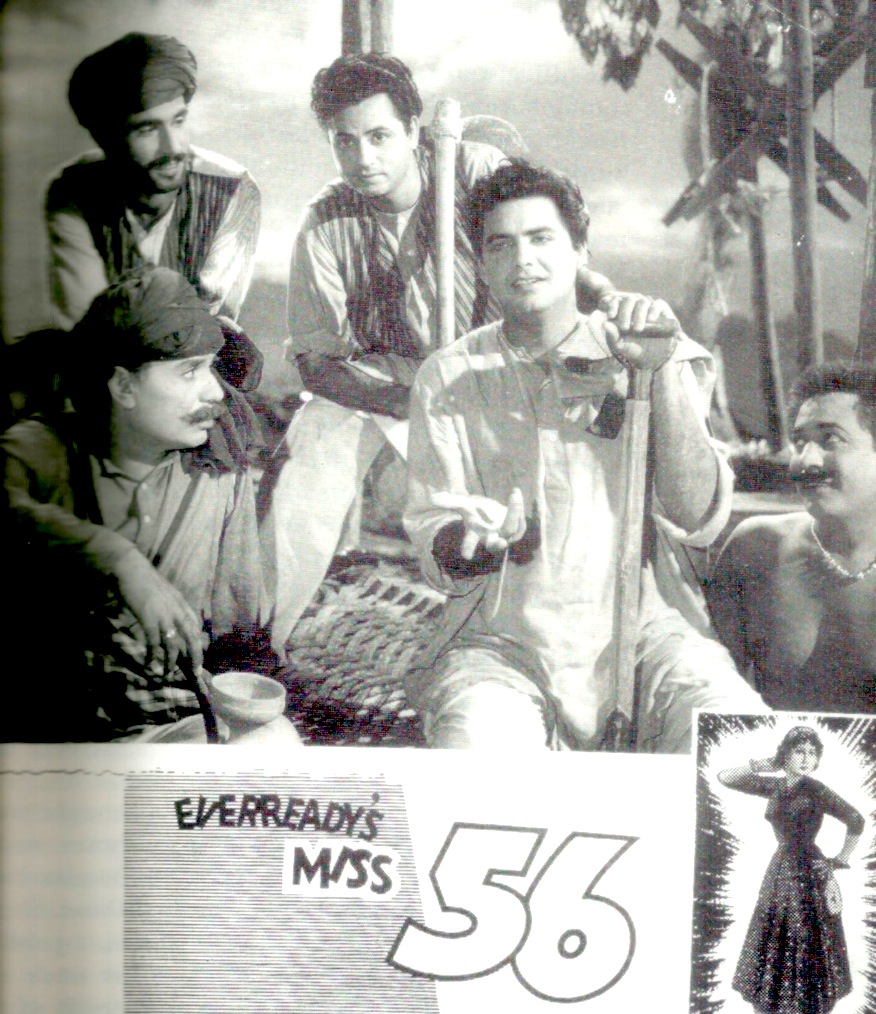
For his other film that year, Miss 56, Anand invited
former Lahore filmmaker Roop K Shorey and his actress wife, Meena Shorey (the
“Lara Lappa” girl) from India to come to Pakistan and make a film for him.
Written by IS Johar, Miss 56 was a comedy centred on the heroine and
banked heavily on Meena Shorey’s comic talents. Among other things, the film
had her chasing the jeep-driving villains on a camel and mimicking a French
lady with the help of a false nose and a huge wig. The film proved to be
average fare, with a reviewer declaring, “The simplicity of approach and the
disproportionately light hearted treatment are surprising, all the more so when
found in the work of a veteran director.”
Miss 56 created a bigger buzz behind the scenes. Seeing
the adulation that she got in Pakistan, and considering the fact that her
career was on the decline in India, Meena Shorey opted to migrate to Pakistan.
The broken-hearted Roop K Shorey returned alone to India.
The following year saw Anand hit his peak. He produced four
out of the 27 films made in Pakistan in 1957 – Ishq-e-Laila, Noor-e-Islam and Murad in
Urdu and the Punjabi biggie, Nooran.
Sticking to his track record of producing epic romances,
Anand’s big hit of the year was Ishq-e-Laila, a retelling of the
Laila-Majnu tale directed by Munshi Dil and starring Sabiha Khanum and Santosh
Kumar. Ishq-e-Laila found itself in competition with another film
with the same story, titled Laila Majnu. Anwar Kemal Pasha, another
prominent Pakistani filmmaker, directed this version with Bahar and Aslam
Parvez as the doomed lovers. Both films were released on the same day on April
12, 1957. The star power of Sabiha-Santosh and Safdar Hussain’s melodious soundtrack
of 14 songs, most of them chartbusters, saw Ishq-e-Laila become a
smash hit at the cost of Laila Majnu.
In contrast to Ishq-e-Laila’s winning run, the big
disappointment that year came with Nooran, Anand’s first and only
collaboration with Noor Jehan. Despite a star cast that included Sudhir as Noor
Jehan’s leading man, the inclusion of a daring bathing sequence involving her,
and the film having possibly the finest musical score of Safdar Hussain’s
career, Nooran failed to shake the box office. The MA Khan
Jr-directed movie is remembered mainly for its wonderful songs sung by the
melody queen at the height of her singing powers.
Anand produced only three more movies. Of these, Hasrat (1958)
with Sabiha and Santosh, performed well. The lead stars married each other
during its making. The subsequent productions Alam Ara (1959)
and Dulhan (1963) were failures.
JC Anand died in Karachi in 1977. He left behind a rich
cinematic legacy not just in his country but also in India. Actress and
producer Juhi Chawla is his sister-in-law’s daughter. JC Anand’s dream
continues in the form of his son, Satish Anand, who runs the Eveready group in
Pakistan. The company has released over 400 films besides producing over 100
television shows and events across the border. Satish Anand made the headlines
in October 2008 when he was abducted, allegedly by the outlawed terrorist group
Harkat-ul-Mujahideen, and released after six months of captivity following the
payment of a huge ransom amount.