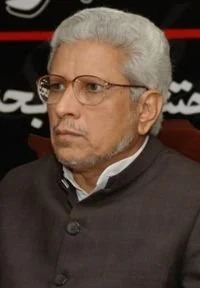
 Pakistani Scholar Mr. Jawed Ahmed Ghamdi
Murder, Manslaughter and Terrorism -- All in the Name of Allah by Mr. Jawed Ahmed Ghamdi
Introduction
Often, criminals are of two kinds: there are those who know that the wrong they do is wrong -- and there are those who think -- who actually believe -- that their deeds are virtuous. When those of the latter category have a religious basis for their activities, they can rarely be dissuaded by legal and penal measures alone, for bearing chastisement is in itself sublime to them -- something that gives them a cause to rejoice in being ‘persecuted for righteousness’ sake’ -- something that only adds to their commitment. The best defence against these people is an attack on the religious foundation their leaders use to convince them. A fortiori, legal and penal measures must be accompanied by propagation of counter arguments. For this purpose, arguments developed on the basis of superficial study won’t do. No one is easily convinced into becoming a murderer on religious grounds and no one is easily dissuaded once so convinced. Only arguments truly emanating from the Qur’an and the Sunnah and cogent enough can be effective. Unfortunately, very little work has been done in the regard by government as well as private institutions.
It is important to know what arguments the militants use to justify their deeds and to see whether these arguments have any basis in the Qur’an and the Sunnah. This dissertation discusses some pertinent issues in this regard, including incendiary questions as the following:
Does Islam give an individual or a group the right to use violence to end wrong? What arguments do the militant Islamists have to justify their acts of terrorism and violence? Is the government of Pakistan un-Islamic? When is an individual or a group allowed by Islam to rebel against the State? What are the punishments in Islam for those who rebel against the State or cause disruption in society? What exactly is the meaning of Jihad and who has the right to wage it? Is ‘turning the other cheek’ a Christian belief only? What are the rules for a preacher in Islam? What is the actual responsibility of religious leaders? Does an individual or a group have the right to declare a Muslim a Kafir? What are the rights of the non-Muslim citizens of an Islamic State? Who has the authority to punish a person or a group for blasphemy? What steps does the government need to take to end violence and terrorism now rampant in our society in the name of religion?
This dissertation, a major part of which is based on Javed Ahmad Ghamidi’s research work (a meritorious religious scholar and founder of Al-Mawrid, an institute of Islamic research), has three sections: the first gives a summary of the main conclusions drawn in the article, the second recommends certain strategies to the government for dealing with sectarian violence and terrorism, and the last section contains the main article. An appendix at the end responds to some criticisms on the views expressed in the dissertation.
I. Summary of the main conclusions
1. Taking the law into one’s own hands amounts to either Fasad fi’l-Ard (creating disorder) or Muharabah (rebellion) -- both of which are punishable by death in Islam.
2. The Prophet’s saying (sws) usually cited to give credence to the idea that Islam allows an individual or a group the use of force to end wrong is actually related to the use of power within the confines of the social and legal authority.
3. In Islam, there is no concept of Jihad (Qital to be more precise -- that is militant struggle in the way of Allah) or the implementation of punishments without the authority of the State.
4. The argument that the government in Pakistan is not Islamic is baseless. In an independent State, any government formed on the basis of amruhum shura baynahum (their affairs are by consultation among them) -- in modern times through the vote of the Muslim citizens in an election -- is an Islamic government so long as the rulers do not unequivocally deny Islam or their faith in it.
5. Rebellion against the State (Khuruj) is allowed -- that is it is permissible not obligatory -- only when all of the following three conditions exist:
i) the rulers unequivocally deny Islam.
ii) the government is a dictatorship and does not have the support of the Muslims and cannot be changed by their vote.
iii) the leader of Khuruj is one who, without any doubt, has the support of the majority of the nation.
Moreover, in case of an armed rebellion, there is an additional condition: the leader of the Khuruj must migrate with his followers to another land and form an independent State.
In the absence of even one of these conditions, those leading the Khuruj can be sentenced to death by the State under Islamic law.
6. Allegiance to the Islamic State and obedience to its government are obligatory on a Muslim even if the rulers are morally corrupt. According to a reported saying of the Prophet (sws), he who detaches himself from the collectivity of the Muslims and dies in that condition dies the death of ignorance.
7. No individual or group has the right to declare a Muslim Kafir (one who deliberately denies Islam; plural: Kuffar). Takfir -- declaring someone a Kafir is the prerogative of either the Prophet (sws) -- who does that through Divine revelation -- or that State which represents the collectivity of the Ummah (the whole Muslim community).
8. The argument of the militant Islamists that their aggression is in self-defence is baseless. The difference between self-defence and aggression is manifest. Also, the law of Qisas in Islam is to be implemented by the State not by any individual or group. The aggrieved person has the right to demand Qisas, and it is the responsibility of the State to provide him with justice. The aggrieved or his heir also has the authority to forgive the offender and demand penalty. But there is no room in Islam for personal vendettas, in which people take the law into their own hands.
9. Religious scholars and leaders of religious movements can best serve Islam by staying out of politics and confining themselves to academic work and Da‘wah (propagation of religion). They must remember that their primary responsibility is Indhar (admonition) and Da‘wah. Their goal should be conquering the hearts of people rather than killing them. For the conquest of hearts one has to be slain rather than slaying others. One has to forgive rather than avenge. And one has to repel evil with goodness.
Some other points of relevance to which this article alluded are:
1. Death punishment for apostasy was confined only to the people the Prophet (sws) was directly sent to -- the Banu Isma‘il. No one can now be punished to death on that basis as no one after the Prophet (sws) can claim to have done Itmamu’l-Hujjah (manifesting the truth to such an extent that no excuse whatsoever is left for a person to deny it) in his individual capacity.
2. There are only two valid reasons for Qital: i) injustice and oppression and ii) Itmamu’l-Hujjah. After the Prophet (sws) no individual or group has the position to do Itmamu’l-Hujjah. Itmamu’l-Hujjah is now possible only when the whole Ummah fulfils its responsibility of becoming 'Ummah Wasat (the best community) by living out the true meaning of its creed and thereby fulfils the responsibility of Shahadah ‘ala’l-Nas (bearing witness to the truth of Islam before other peoples of the world). After fulfilling this responsibility, the State representing the collectivity of the 'Ummah has the right to depose such rulers of the vanquished nations as deliberately deny their people access to the message of Islam. But that State does not have the right to coerce people into accepting Islam. These non-Muslims would only be required to remain subservient to the Islamic State and to pay it their equitable dues and in return would receive protection and have all their basic rights ensured.
3. Lynching non-Muslim citizens of an Islamic State for blasphemy is absolutely against Islam even if the criminal is caught red-handed. Punishing a person or a group for any crime against anybody is the prerogative of the Islamic State -- which does that through its organ, the judiciary, after determining for sure that the crime had actually been committed and deciding on the appropriate punishment.a No individual has the right to take the law into his own hands on any account. Even the closest of the Prophet’s companions (sws) never killed a single of his opponents even when invectives were hurled at him day and night in the first thirteen years of his Da‘wah at Makkah. Nor did they kill anyone in retaliation when he was pelted with stones at Ta’if.
II. Recommendations:
In relation to the points discussed above, the following measures are suggested to the government of Pakistan:
i) The government should use its propaganda machinery -- including the mass media -- to dissuade youngsters from falling into the trap of those religious leaders who equate terrorism and sectarian violence with Islam. The government should take help from genuine scholars of Islam for this purpose and present its views on the solid basis of the Qur’an and the Sunnah. It should become obvious to every man and woman -- even to the militant Islamists themselves -- that the violence and terrorism of the militant Islamists is absolutely against Islam.
ii) Known and self-proclaimed offenders should immediately be arrested or shot on sight for Muharabah, and Fasad fi’l-Ard. The arrested criminals should be punished on these bases in an exemplary manner. The government should publicise the reasoning behind these punishments so that everyone is aware of the correct stance in this regard and potential offenders are deterred from the path of violence.
iii) Those religious organisations which believe in rebellion against the State should be given a stern warning. The correct picture of Islam regarding Khuruj should be publicised a great deal so that sufficient ground work is done to make the masses mentally accept the idea of the government crushing the very first insurrection to nip the evil in the bud. And that the government should do: completely crush the first insurrection to emerge so that no one is encouraged by the rebels to follow suit.
iv) The government should take steps to eliminate the duality in our education system. Religious schools breed sectarianism and modern schools breed scepticism. To deal with this problem, our education system needs to be changed. Unless the modern, educated people -- especially those belonging to the elite and affluent classes -- are instructed at least in the basics of religion, the monopoly and influence of sectarian schools is bound to remain.b
v) The mosque has a very important role to play in an Islamic society. Few people today realise the extent to which this institution influences the minds of the masses. Unfortunately, mosques in our society have become citadels of sectarianism. There is great need to overhaul this institution. The key point here is that the Mosque is a State institution and the elected representatives of the people running their State affairs ought to be their leaders in prayer rather than the mullahs. The Sunnah in this regard is that the Head of the State and his representatives in the administration should lead the Friday prayer. On the basis of the Sunnah, one can suggest that the government should supervise the mosques and not let any particular sect control them. A number of steps should be taken in this regard:c
a) The centre of every administrative unit of the State should be a Jami‘ Masjid, and the division of these units should be such that one Jami’ Masjid should suffice for one unit.
b) Within each unit, all the administrative offices and courts should be instituted adjacent to this Jami’ Masjid.
c) The State capital, together with the provincial capitals, should have a central Jami’ Masjid.
d) The address of the Friday prayer should be delivered only by the Head of State and only he should lead this prayer in the central Jami’ Masjid of the capital. The provincial governors should be entrusted with this job in the central Jami‘ Mosques of the provinces, while the representatives of the government should perform this duty in the Jami‘ Mosques of the various administrative units.
e) The Friday prayer should be prohibited in all mosques except the above ones.
f) Mosques should be supervised by the government itself.
g) Any religious scholar should be allowed to teach, educate and instruct his students according to his own views in any of these mosques.
vi) The government should make it clear to all Muslims that there is no room for lynching in Islam. No one can be punished for blasphemy unless his crime is proved in a court of law and only the State has the right to execute the sentence. It should also be made clear that violation of the rights of non-Muslims in an Islamic State is a serious offence.
Whether a Mu‘ahid or a Dhimmi d , the rights guaranteed to a non-Muslim must not be violated by any Muslim. The Qur’an says:
And fulfil the covenant. Verily the covenant shall be questioned about. (17:34)
The Prophet (sws) is reported to have said:
Beware! He who oppresses a Mu‘ahid or does him injustice or burdens him more than his strengthe or takes anything from him without his consent, I myself shall plead against him on the Day of Judgement. (Abu Da’ud, Kitabu’l-Jihad)
These words of the Prophet (sws) should be enough for any Muslim to realise the gravity of the sin of oppressing a Mu‘ahid. Even in case of enmity, the Qur’an does not allow the Muslim to do anything against the principles of equity and justice. f
Therefore, unless a Mu‘ahid is found guilty of some crime by a court of law -- in which case it is up to the court to decide what punishment is to be meted out --, he has the right as a citizen of an Islamic State to demand the protection of his life, honour and property and to demand all his fundamental rights including the right to practice and preach his religion in a manner which does not cause disruption in society.
III. Text of the dissertation:
Murder, Manslaughter and Terrorism
-- All in the Name of Allah
The Qur’an says:
... that whoever took a life1, unless it be for murder or for spreading disorder on earth 2, it would be as if he killed all mankind; and whoever saved a life, it would be as if he saved all mankind. (5:32)
And:
And he who kills a believer intentionally, his reward is Hell; he shall remain therein forever... (4:93)
How can someone who believes in this book commit murder?
Here’s how:
In his mind -- and perhaps even in his heart -- the murder he commits is not murder: it is an act of virtue.
Those who do evil can be of two kinds. There are those who know that the evil they do is evil, and there are those who don’t. In fact, those of the latter kind might even be absolutely certain that the evil they do is not evil but virtue. When that is the case, murder and terrorism can, in their minds, become Jihad.
The good intentions of these ‘pious evil-doers’ might become an excuse for them on the Day of Judgement, but in this worldly life of ours, when murder and terrorism are the issue, their error of judgement -- howsoever noble their intentions might be -- does not, in any way, exonerate them from the responsibility for causing disruption and disorder in society. Therefore, these people need to be dealt with -- and when human lives and law and order are at stake, there can be two ways of doing that: either you succeed in convincing them that their ‘virtue’ is actually evil and that their Jihad is in reality Fasad3 or Muharabah4 or you simply ‘wipe ’em out’.
Two pertinent questions are: how do you convince them? and would the State be morally justified if, after having taken reasonable measures to solve the problem through dialogues and discussions, it has to... well, ‘wipe ’em out’?
To convince such Islamist groups as resort to murder and terrorism that, howsoever noble the goals, their methods are against the teachings of their own religion, one has to understand the arguments they themselves use to justify their deeds. Of such arguments some of the more important ones are discussed here.
One of their arguments is based on a narration in which the Prophet (sws) is reported to have said:
He amongst you who sees any wrong should change it with his hand5; if that is not possible for him, then with his tongue; if that is not possible for him, then [he should condemn it] in his heart -- and that is the weakest level of faith. (Muslim, Kitabu’l-Iman)
This statement of the Prophet (sws) has a specific context in reference to which the statement merely means that it is the duty of every Muslim to try for the eradication of evil within the confines of the social and legal authority he or she has6. For example, parents are afforded the authority by the conventions of society to use some mild form of physical punishment, if required, for the proper upbringing of their children. This obviously does not mean that they have the authority to batter their children. Similarly, the government -- a court of law to be more precise -- has the legal authority to award a suitable sentence to an offender if he is found guilty. Now, if some parents did not use their authority to stop their children from becoming heroin addicts, they would certainly be at a weaker level of faith, especially if physical punishment of a sort would have helped and it were love which stopped them from using their authority. Love does not mean that you let those you love do wrong. Similarly, a judge who, under some pressure, gave a lighter punishment to an offender would certainly be at a weaker level of faith. Indeed, in the absence of a reasonable excuse, he might even be regarded as being devoid of faith altogether on the Day of Judgement.
The Prophet of Allah (sws) never took the law into his own hands. During the thirteen years he preached Islam in Makkah, he never went beyond the confines of the law of the land. The few companions and followers he had during those years were indeed more loyal to him -- and hardly any Muslim would doubt that -- than his followers today can ever claim to be. Many a Muslim today will hardly take any time to decide that it is a matter of his faith to kill anyone -- even the most influential person around -- who blasphemes -- or is even suspected of blaspheming -- against the Prophet (sws). But the followers of the Prophet (sws) never murdered even a single of his opponents even when he was pelted with stones at Ta’if. In Makkah, invectives were hurled against him day and night, yet none of his followers regarded it a matter of his faith to kill a few offenders to avenge the Prophet (sws). Had all of his companions -- even those truly close to him as Abu Bakar (raa) and Ali (raa) -- chosen to remain at a weaker level of faith? And had the Prophet (sws) himself chosen not to do anything about the weak faith of his companions? Why didn’t he exhort them to do something in retaliation?
It was only after the Prophet (sws) had established an independent State at Madinah that laws were enacted and implemented by him -- and that too was done gradually so as to avoid imbalance in society. The reason for this restraint is that in Islam armed struggle is allowed only at the level of the State. An individual or a group is not permitted to wage an armed struggle so that anarchy does not prevail in society.
Militant struggle by an individual or a group in an Islamic State amounts to Fasad (disorder, disruption, etc) or, when it becomes a rebellion against the State, Khuruj (rebellion, revolt, etc). In either case, the Islamic State has the right to give the militants a severe death sentence.7 Only when certain conditions have been met is Khuruj allowed.8
The militant Islamists would argue that (a) the government in Pakistan is not Islamic and (b) they -- the militants -- are fighting against Kuffar (sing. Kafir: infidel), who ought to be killed to save Islam from its enemies.
It should be obvious from the points made above that even if Pakistan were not an Islamic State and some of those accepted by the State as Muslims were Kuffar, there would still be no room in Islam for the militant Islamists to take the law into their own hands and kill people. The militants are not more pious than the Prophet (sws) and his close companions (raa).
But let’s take a look at this stance as well. Does a State having a morally and religiously corrupt government become un-Islamic? And who has the right to declare a group (or a person) in the Ummah (the whole Muslim community) as non-Muslims or Kuffar?
The Islamic principle on which a State is founded is described in the Qur’an in the words amruhum shura baynahum (their affairs are through consultation amongst them)9. This principle entails that the State affairs be run by the vote of the majority of Muslim citizens. A State is formed when a people establish their government in a geographically independent area over which they have power and authority. Therefore, when the majority of Muslims in a geographically independent area, over which they have power and authority, form their own government through consultation -- elections in modern times --, that government, in accordance with the verse quoted above, represents the Islamic State. Therefore, allegiance to that government is a religious obligation on the Muslim citizens of that State:
Obey Allah and the Prophet and those who are in authority among you. Then if there is difference of opinion among you, refer it back to Allah and the Prophet (The Qur’an 4:59)
It is evident from this verse that even in case of any difference of opinion regarding the interpretation of the contents of religion, the matter should be resolved through the Qur’an and the Sunnah10 rather than through guns. And, from the verse quoted earlier (42:38), it is clear that the verdict of the majority of the Muslims regarding the correct interpretation must be accepted as the law of the land. Thereafter, those who dissent do have the right to express their points of view in a peaceful and constitutional manner, but they do not have the right to create a law and order situation or rebel against the State. The Prophet (sws) is reported to have said:
You are organised under the rule of a person and someone tries to break your collectivity apart or disrupt your government, kill him. (Muslim, Kitabu’l-Imarah)
It is only when a Muslim is ordered to do something against the directives of Allah or of the Prophet (sws) is he required to disobey those with political and legal authority in the system he lives in. The Prophet (sws) is reported to have said:
Whether they like it or not, it is obligatory on the faithful to listen to and obey their rulers except that they be ordered to commit sin. If they are ordered to commit sin, they should neither listen nor obey. (Muslims, Kitabu’l-Imarah)
The Qur’anic words ‘obey Allah and the Prophet...’ require that a Muslim not obey any command against the directives of Allah and the Prophet (sws). But even then, he is not allowed to disrupt the system or commit murders. The reason is that when a government is formed in accordance with the Qur’anic principle of amruhum shura baynahum and can be changed or deposed on the same basis, any rebellion against that government amounts to a rebellion against the collectivity of Muslims, which in Islamic terminology, is Muharabah and which, as the statement of the Prophet (sws) quoted earlier explains, is an offence punishable by death.
Prominent people of this Ummah as Abu Hanifah, Imam Malik ibn Anas and Ahmad Ibn Hambal never resorted to violence, vandalism, terrorism or rebellion in spite of facing extreme hardships to propagate the truth.11 In Al-Masa’il al-Rasa’il al Marwiyyah ‘an Ahmad ibn Hambal, Ahmad ibn Hambal is reported to have said:
Far be it from Allah [all that is wrongly associated with Him], blood is but blood12. I do not believe in it nor do I recommend it. Enduring what is on us13 is better than disruption, in which blood is shed, people’s wealth is expropriated and things and matters sacred are desecrated.14
The Prophet (sws) is reported to have said:
I order you five things: pledging allegiance to the State, listening to and obeying [your rulers in that State], Hijrah15 and Jihad in the way of Allah. (Musnad Ahmad Ibn Hambal)
In the same collection of his sayings, the Prophet (sws) is also reported to have said:
He who sees something despicable in his ruler should bear with it, for he who detaches himself to the slightest degree from the State and dies in that condition shall die the death of ignorance. (Kitabu’l-Fitan)
In another version, the Prophet (sws) is reported to have said:
He who sees something despicable in his ruler should bear with it, for he who detaches himself to the slightest degree from the Sovereignty and dies in that condition shall die the death of ignorance (Kitabu’l-Fitan)
In these two versions, the words Al-Jama‘ah (the State) and Al-Sultan (the Sovereignty) have been used interchangeably, which clearly shows that this directive of the Prophet (sws) pertains to such a body as has political sovereignty in a geographically independent area in which there is a system of government.16
It should be obvious from the arguments given above that the government in Pakistan, which is brought to power through the mandate given to it by the majority vote of the Muslim citizens is the embodiment of the sovereignty of the State and as such it represents the State. Therefore, even if the rulers are morally corrupt, a Muslim does not have the right to disrupt the government or resort to terrorism. It is indeed his duty to propagate the truth with wisdom and sagacity and, if need be, with personal sacrifice. The way the likes of Ahmad Ibn Hambal, Malik Ibn Anas and Abu Hanifah bore persecution at the hands of the rulers of their respective times is a testimony to the fact that the prominent scholars of Islam have never shirked from making sacrifices for the sake of truth, yet have always distanced themselves from vandalism, terrorism and disruption. Indeed, it is this kind of propagation which was termed as a great Jihad by the Prophet (sws). He is reported to have said:
Verily, words of truth and justice are a great Jihad especially when said in front of an oppressive ruler. (Tirmidhi, Kitabu’l-Fitan)
Rebellion against the State is allowed only when certain conditions have been met. A brief mention of these conditions would not be out of place here:
The first condition is that the rulers unequivocally deny Islam or any of its directives. The fourth verse of the 59th chapter of Qur’an quoted earlier points out that obedience to rulers is obligatory as long as they are from within the Muslims (‘those in authority among you’).
The Prophet (sws) is also reported to have laid down the same condition for refusal to accept the authority of the rulers.
... when you see unequivocal denial by them and in a matter regarding which you have an explicit directive from Allah. (Muslim, Kitabu’l-Imarah)
The second and the third conditions, based on amruhum shura baynahum -- ‘their affairs are by consultation among them’ (the Qur’an 42:38) --, are that the government against which Khuruj is taken place should be a dictatorship which does not enjoy the support of the masses and that the leader of the Khuruj should be a person who has the indubitable support of the nation.
All these conditions are essential in that even if one of them is missing, Khuruj is not permissible.
Furthermore, in case of militant struggle, there is another condition: the rebels must migrate to another land and form an independent State there.
Before discussing the basis and the reason for this condition, it would be pertinent to point out here that the militant Islamists often term all their subversive activities as Jihad. Actually, Jihad is a nomen verbum of Jahada, which means to make one’s utmost effort. In Islamic terminology, the word denotes one’s utmost effort in the way of Allah. One of the connotations of the word is making one’s utmost effort in a militant struggle for Allah. In that sense it is used as a synonym for Qital fi sabil Allah (killing in the way of Allah), which is the more precise term for any kind of militant religious struggle -- be it a battle or war or a rebellion (Khuruj). And in any case, Qital fi sabil Allah is a prerogative of the State. In other words, in Islam there is no concept of Jihad or Qital17 of any kind without the authority of the State.
The basis for this condition is that God Almighty did not ever give the permission to use the sword even to the Prophets (sws), who are the final manifestation of the truth for their people, until they had established their rule over their followers as their political sovereigns after migrating with them to another land and forming an independent State there. Moses (sws) was given the directive for Jihad only after this condition had been met and, similarly, the Prophet (sws) and his followers were also allowed to do Jihad only when after the Pledge of ‘Aqabah they were able to establish an independent State at Yathrib (later known as Madinah).18
The reason for this condition is that without the authority of the State Jihad often becomes Fasad. A group which does not even have the legal authority to sentence a criminal cannot be allowed to gamble with the lives and property of people. For this reason, Muslim jurists have always regarded this condition as essential:
And the third category of collective duties is one in which [the authority] of the Head of the State is a necessary condition, for example Jihad and the implementation of the Islamic law of punishments. (Al-Syyid Al-Sabiq, Fiqhu’l-Sunnah, vol. 3, p.30)
Hamidu’l-Din Farahi writes:
Jihad in one’s own country is not allowed unless one migrates to another land.
Accounts of Abraham’s life (sws) and other verses [of the Qur’an] related to Hijrah19also point up this principle. The events of the Prophet’s life (sws) also corroborate it. The reason for this principle is that without the authority of one who represents the collectivity of the Muslims in the State and has political sovereignty, Jihad is merely chaos and disruption and anarchy and disorder (Majmu‘ah-i-Tafasir-i-Farahi, p. 56)
A prominent exegesist of the Qur’an, Amin Ahsan Islahi, makes the following comments on the same principle:
The first reason [for this condition] is that God Almighty does not like the disruption and disintegration of even an evil system until a strong probability exists that those out to disintegrate the system will provide people with an alternative, righteous system. Anarchy and disorder are unnatural conditions. In fact, they are so contrary to human nature that even an unjust system is preferable to them. For this reason, God Almighty has not given the right to wage war to a group which is dubious and obscure, the power and authority of which is undefined, which is without the sovereignty of a ruler, the loyalty and obedience of which is untested and the members of which are disorganised and undisciplined -- who can disrupt a system but cannot prove that they have the ability to integrate a disintegrated environment. This confidence [that a group will be able to create harmony and integrate a disorganised environment into an organised system] can only be reposed in such a group as has actually formed a political government and has such control and discipline within the confines of its authority that it can be termed as Al-Jama‘ah20. Until a group attains this position, it can strive to become Al-Jama‘ah [through religiously allowable and through legal and constitutional means] -- and that endeavour of its would be its Jihad for that time -- but it does not have the right to wage an armed Jihad and a war.
The second reason is that the import of the authority which a group engaged in war gets over the life and property of human beings is so great that such authority cannot be given to a group in which the authority of the leader over his followers is merely moral21. Mere moral authority is not a sufficient guarantee that the leader will be able to stop his followers from Fasad fi’l-Ard22. Therefore, a religious leader does not have the right to allow his followers to take out their swords23 merely on the basis of his spiritual relationship with them, for once the sword is unsheathed there is great danger that it will not care for right and wrong and that those who drew it will end up doing all [the wrong which] they had sought to end. Those revolutionary groups the object of which is nothing more than disruption of the existing system and deposition of the ruling party to seize power for themselves play such games -- and they can, for in their eyes disruption of a system is no calamity, nor is cruelty of any kind an evil. Everything is right to them [as long as it serves their purpose]. However, the leaders of a just and righteous group must see whether they are in a position to provide people with a system better than the one they seek to change and whether they will be able to stop their followers from doing such wrong as they themselves had sought to root out. If they are not in that position, then they do not have the right to play games with the lives and property of people on the basis of their confidence in mere chances or create greater disorder than the one they had sought to end.24
It should be obvious from the passage quoted above that the right to wage war cannot be given to a group of individuals, who do not even have the legal authority to award punishment to a criminal. Without political sovereignty, Jihad is often nothing short of Fasad. Thus, such militant groups as mislead their followers into believing that their terrorism is a form of Jihad have no Islamic basis whatsoever for their claim.25
Now, let us analyse the next argument of the Islamist militants: that they only kill Kuffar26, who are out to destroy Islam. Let’s see who is really a Kafir (singular of Kuffar) and who is not. And let’s also take a look at whether any individual or group has the authority to declare a Muslim a Kafir.
Takfir, or declaring anyone a Kafir, is the prerogative of either the Prophet (sws) -- who does that on the basis of Divine revelation -- or the Muslim Ummah (the whole Muslim community). No other individual or group has that right.
The reasons for this principle are as follows:
A Kafir in the true sense of the word is one who denies the truth even after it becomes absolutely clear to him. Revealing the truth to a person or a group so clearly that no excuse is left for that person or group to deny it may be termed as Itmamu’l-Hujjah.
The Prophet (sws) was the last messenger of God. With his status as a Rasul,27 the Prophet (sws) was in a position to do Itmamu’l-Hujjah even as an individual.28 No one after him has that privilege. No individual or group can do Itmamu’l-Hujjah now because no individual can claim that his propagation has manifested the truth to the extent that no excuse is left to deny it. Indeed, an individual cannot even be absolutely certain of having understood the truth absolutely correctly. He can only be certain that God will reward him for doing his duty as he has been given the light to see it. Only the Prophet’s word (sws) was final in religion.
After the Prophet (sws), the responsibility of bearing witness to the truth of Islam has been passed on to the Ummah (the whole Muslim Community) rather than to any individual or group as it would have been impossible for anyone to fulfil this responsibility in his individual capacity. For this purpose, it is incumbent upon the Ummah to strive for becoming an Ummah Wasat (the best people) so that by its very existence it can become a living testimony to the truth of its religion. It is the responsibility of every individual in the Ummah to do his part to ensure that the Ummah become and remain Ummah Wasat-- an Ummah which is the paragon of truth, justice and compassion. The Qur’an calls this responsibility Shahadah ‘ala’l-Nas (testimony before the29 people) and the style of the address in the relevant verses clearly shows that after the Prophet (sws) this responsibility has been passed on to the Ummah as a whole.30
An obvious corollary to the points made above is that only the State representing the collectivity of the whole Ummah has the right to declare a person Kafir as no Muslim in his individual capacity and no group of Muslims can possibly fulfil the obligation of Shahadah ‘ala’l-Nas.
However, this principle does not mean that a Muslim should be indifferent to dissents and heresies in religion. It is especially incumbent upon scholars and intellectuals to carry on the task of Da‘wah (propagation of the truth) and of Indhar (admonition).
Experience has shown that scholars and intellectuals can best fulfil this responsibility by staying out of politics. It is indeed very fortunate when a political leader is religious, but when a religious leader is political he usually ends up being neither a politician nor a religious leader. Moreover, religious leaders need to understand that there are occasions when speaking out the truth is a requirement of faith and there are occasions when restraining oneself is a requirement of sagacity -- and that the Qur’an requires Da‘wah with wisdom and sagacity: a Da‘wah which vanquishes the hearts of people rather than killing or battering them.31
Some militant Islamists also argue that their militancy is for self-defence. Their argument is that as a result of their Da‘wah, opposing groups become aggressive, which entails self-defence.
There is a big difference between what can legitimately be termed as ‘self-defence’ and the ‘aggression for the sake of self-defence’ that these Islamists usually commit. Extending the meaning of self-defence to include downright aggression is carrying things too far. Many of these groups argue that not retaliating to aggression is a Christian attitude of ‘turning the other cheek’. Islam gives the concept of Qisas, an eye for an eye and a tooth for a tooth.
It should be borne in mind that an Islamic State has not only the responsibility but also the sole authority to implement the Law of Qisas. Qisas has often been rendered into English as ‘retaliation’32 -- a translation which has misled many into believing that personal vendettas are allowed -- in fact encouraged -- in Islam (for example, a report on terrorism ‘Bosnia -- A Springboard for Terrorism’ prepared by a special task force of the U S Senate presents the same view of Islam, which viewpoint is further stressed in the Task Force’s reply to a letter of protest by the American Muslim Council). It seems that the argument rests on an incorrect understanding of a Qur’anic verse:
And whoever is killed unjustly, We have given his heir the authority. Therefore, he [the heir] should not exceed in killing, for verily he has been helped. (17:33)
The last part of the verse ‘for verily he has been helped’ refers to the fact that the State and the law are on his side. ‘We have given his heir the authority’ means that the heir has the authority to either demand Qisas or forgive the offender. ‘He should not exceed in killing’ means that since the society is now on the heir’s side he should not exceed the limits either by taking the law into his own hand or by demanding a greater punishment than what the offender actually deserves. The way the whole society has specifically been addressed in other pertinent Qur’anic verses (6:178 & 179 and 5:45) proves beyond doubt that the directive of implementing the law of Qisas pertains to the whole society -- which obviously works through the State and its organs (as the judiciary in this instance). Therefore, lynching and engaging in personal vendettas have no room in Islam. As already explained, prominent Muslim jurists have always maintained that in some matters related to the collectivity of the Muslims, the authority of the Sovereignty is a necessary condition, for example Jihad (that is Qital) and the implementation of the law of punishments (Iqamatu’l-Hudud):
And the third category of collective responsibility is that in which the authority of the Sovereignty is a necessary condition, for example Jihad and the law of punishments.33
Nothing could be farther from the truth than the idea that Qisas refers to retaliation by an individual or a group. Such retaliation, even if equal harm is done to the offender, simply negates the purpose of the law of Qisas. The words of the Qur’an ‘In Qisas there is life for you’ refer to the fact that when the State does not provide the people in a society with justice, they often resort to personal vendettas and revenge, which shake the very foundation on which the edifice of a social set-up rests.
A Muslim who has been wronged has the right to demand Qisas and it is the duty of the State to provide him with justice. The Qur’an entails that much. But the Qur’an also goes further than that. It gives a high place to an attitude of forgiveness. Turning the other cheek is not merely a Christian attitude. Jesus (sws) was not telling the judge in a court of law to turn the other cheek while deciding the fate of a serial killer. He was not telling that to the State facing an enemy State in war. He was telling that to a preacher out to conquer the hearts of people. To conquer hearts one never slays, but is slain. One does not take revenge, but forgives. These are the rules for a preacher. Though not the law, they are a great honour and a great privilege. The Qur’an says:
The good and the evil are not equal. Repel evil with that which is better than all others; then you will see that he, between whom and you there was enmity, has become as if he were a truly close friend. And this sagacity is not afforded to anyone except those who persevere and this wisdom is not granted except to those who are indeed very fortunate. And if you feel any evil incitement from Satan, seek refuge of Allah. Verily, He is the Hearer, the knower. (41:34-36)
This is the attitude of a Muslim towards those who wrong him because of his Da‘wah -- an attitude the Qur’an terms as something truly sublime. With this line of thinking, how is it possible to think of retaliation and personal vengeance? And more than that, how is it possible for any Muslim to believe that he will be able to justify himself on the Day of Judgement for killing innocent people?


